
Every renovation contract needs eight non-negotiable clauses: full identification of both parties and every governing document, a detailed scope of work with named materials, a total price with a milestone-based payment schedule that respects holdback rules, a written change order process, clear permit and inspection responsibilities, proof of insurance and workers’ compensation coverage, a defined warranty and defect correction procedure, and termination rights with a dispute resolution path. The sections below walk through each one with sample language, a printable checklist, and the reasoning behind why contractors and lawyers keep coming back to the same clauses.
TL;DR:
- Payment milestones should be based on verified project progress, with a holdback typically of 10% held until all subcontractors are paid and lien periods expire.
- The scope of work must be detailed with brand and model specifications, room-by-room breakdowns, and explicit exclusions to prevent disputes.
- Change orders require written, signed approval before work begins, with clear pricing formulas and impact on project timeline.
- Contractors should be responsible for permits and insurance proof, with deadlines for permit application and delivery of certificates to ensure code compliance and liability protection.
- Dispute resolution should follow a sequence starting with written notices, response periods, and mediation, before escalating to arbitration or court if necessary.
Statera Contracting — Plan Your Calgary Renovation Clearly. Statera Contracting handles kitchens, bathrooms, basements, additions, exterior work, and commercial renovations in Calgary and nearby areas. Explore renovation services
Table of Contents
- What are the essential renovation contract clauses?
- How detailed should the scope of work be?
- What payment structure and holdback rules protect your money?
- What should the change order clause say?
- How should the schedule and delay clauses read?
- Who is responsible for permits and inspections?
- What insurance and safety proof should you require?
- How long should workmanship warranties last?
- What happens if the contractor defaults?
- Sample clauses and a pre-signing checklist
- How do payment delay penalties work?
- What are lien waivers and release provisions?
- Do renovation contracts need confidentiality clauses?
- What are the escalation steps before mediation?
- How contractors think about clauses, and how to negotiate them
- How Statera Contracting handles contracts differently
- Sources
What are the essential renovation contract clauses?
The clause that causes the most grief later is the one nobody bothered to write down properly at the start: identification of who is actually signing the deal, and which documents count as part of it.
That sounds basic, but it trips up more homeowners than you’d think. A contract that names “Smith Renovations” instead of the registered legal entity, or that references drawings “to be provided later,” creates a document nobody can fully enforce.
Your renovation contract should include:
- Full legal names and addresses of the homeowner and the contractor, not just a business name on a truck door.
- The contractor’s business number, GST/HST registration, and a named primary contact for the project.
- A complete list of every document that forms part of the agreement, including drawings, material specifications, selection sheets, and any signed change orders.
- Version control on those documents, meaning dated revisions and a note on which version is currently binding.
- A clause stating that no verbal promise, no matter who made it on site, changes the contract unless it’s added in writing.
Consumer guidance from the Office of Consumer Affairs is blunt about this: homeowners carry legal responsibility for what happens on their property, so the paperwork identifying who’s doing what needs to be airtight before a hammer swings. If your contract is missing an attachment list, ask for one before you sign anything.
How detailed should the scope of work be?
The scope of work is where most renovation disputes are born, and it’s almost never because a contractor set out to cut corners. It’s because “renovate the kitchen” was never translated into anything specific enough to hold anyone accountable.
The Office of Consumer Affairs puts it plainly: a scope of work should be detailed enough that a stranger reading it could describe the finished project, right down to product numbers for cabinets, faucets, and flooring. Vague language like “standard fixtures” or “builder grade finishes” gives a contractor room to install the cheapest available option and still be technically compliant.
Here’s how to structure a scope that actually protects you:
- Break it down room by room. A kitchen renovation isn’t one line item. It’s demolition, electrical, plumbing rough-in, cabinetry, countertops, backsplash, flooring, and finishing, each with its own specification.
- Name materials by brand, model number, or code. “Quartz countertop, 3cm, Caesarstone Pure White or equivalent” leaves far less room for argument than “quartz countertop.”
- List exclusions explicitly. If asbestos abatement, structural repairs, or window replacement aren’t included, say so in writing. Silence on exclusions gets read as inclusion when a dispute lands in front of a mediator.
- Document allowances with real numbers. If tile selection is pending, set a per-square-foot allowance, a deadline for the homeowner to choose, and a clear method for reconciling the difference if the final choice costs more or less.
- Attach drawings and specification sheets as signed exhibits, not as email attachments floating outside the contract itself.
Pro Tip: Ask your contractor to walk through the scope of work out loud, room by room, before you sign. If they hesitate or get vague on any line item, that’s the line item that becomes a change order later, usually at a worse price than if it had been planned from day one.
Allowances deserve extra attention because they’re where budgets quietly balloon. A $3,000 lighting allowance sounds generous until you fall in love with a fixture that costs $4,200. The contract should spell out who eats that difference and when the decision needs to be locked in, ideally tied to a specific date rather than a vague “before installation” window that can slip for weeks.
What payment structure and holdback rules protect your money?
Renovation contracts generally use one of two pricing models, and the difference matters more than most homeowners realize when they’re signing. A fixed-price contract sets one total for the defined scope, which works well when specifications are locked down before work starts. A cost-plus contract bills actual materials and labour plus a markup percentage, which suits projects with genuine uncertainty, like a basement renovation where nobody knows what’s behind the drywall until it comes down.
Whichever model you use, payments should never be tied to calendar dates. Legal guidance from Treadstone Law recommends tying every payment to a verifiable, completed milestone instead, such as:
- Contract signing and mobilization (deposit)
- Rough-in complete (electrical, plumbing, HVAC roughed in and inspected)
- Drywall complete
- Substantial completion (the space is usable, minor items outstanding)
- Final completion (punch list cleared, final payment released)
Tying money to milestones rather than dates means you’re never paying for progress that hasn’t actually happened, and it gives you leverage if a project stalls.
Holdback rules add another layer of protection that many homeowners have never heard of until they need it. Provincial builders’ lien legislation typically requires a percentage of the contract value, commonly 10%, to be held back for a set period after substantial completion, giving subcontractors and suppliers a window to file a lien if they haven’t been paid by the general contractor. If you release full payment before that holdback period expires, you can end up paying twice: once to the contractor, and again to a subcontractor who files a lien against your property because the contractor never paid them.
The Canada Construction Network recommends building contingency planning directly into the payment clause, since surprises during demolition are the rule rather than the exception, especially in older homes. A holdback isn’t a sign of distrust in your contractor. It’s a standard mechanism that protects you from a subcontractor dispute you had nothing to do with.
What should the change order clause say?
Change orders are where good contracts either hold up or fall apart. Every renovation shifts once the walls come open, and the question isn’t whether you’ll want to change something. It’s whether that change gets documented before it happens or argued about after.
A solid change order clause needs to cover:
- A written, signed requirement for any variation to the scope. No exceptions for verbal agreements made on site, even friendly ones.
- A clear pricing formula agreed upfront, whether that’s cost of materials plus labour plus a stated markup percentage, or a lump sum quoted before the work proceeds.
- A rule that verbal on-site requests are not binding until they’re written up and signed by both parties, ideally before the related work begins.
- Payment timing language, specifying whether the change order amount is due immediately, added to the next milestone payment, or held until completion.
- Timeline impact disclosure, meaning the change order states whether the addition extends the completion date and by how many days.
Practical experience backs up why this matters more than it seems: verbal on-site promises are consistently the most common cause of post-completion disputes because memories of a hallway conversation rarely match once the invoice arrives. If your contractor mentions an idea on site, treat it as a conversation starter, not a commitment, until it’s in writing with a price attached.
How should the schedule and delay clauses read?
A renovation timeline is only useful if the contract defines its terms precisely. “Start” should mean the date mobilization and demolition begin, not the date the contract was signed. “Substantial completion” should mean the space is livable and usable for its intended purpose, with only minor deficiencies remaining. “Final completion” should mean every item on the punch list has been resolved and signed off.
Delays happen on almost every renovation, and the contract needs language distinguishing between delays the contractor should own and delays nobody controls. Reasonable force majeure language excuses the contractor for events genuinely outside anyone’s control:
- Extreme weather that halts exterior work or delivery
- Government-ordered shutdowns or material shortages tied to supply chain disruption
- Labour strikes affecting subtrades or suppliers
- Acts of nature that damage the site or block access
Force majeure should never cover poor scheduling, understaffing, or a contractor juggling too many projects at once. If a delay clause is written broadly enough to excuse anything, it protects the contractor at your expense.
For homeowners who want extra leverage on timeline-sensitive projects, a liquidated damages clause sets a modest daily credit, for example $100 per day past an agreed completion date, for delays that are the contractor’s fault and not covered by force majeure. This only works if the amount is reasonable rather than punitive, and most residential contracts skip it entirely in favour of simply holding final payment until the punch list clears.
Who is responsible for permits and inspections?
Permit responsibility needs to be assigned in writing, and it needs to be specific about who applies, who pays the fees, and who delivers copies once approval comes through.
Most renovation contracts make the contractor responsible for pulling permits and scheduling inspections, since they’re the one managing the trades and the timeline. The contract should require:
- The contractor to apply for all required permits before work begins on any portion requiring one.
- Delivery of permit copies and inspection sign-off documents to the homeowner as they’re issued, not bundled at the end of the project.
- A defined timeline for permit applications, so a slow municipal process doesn’t quietly stall the whole job without anyone flagging it.
Here’s the detail that catches homeowners off guard: even when the contract makes the contractor responsible for permits, the Office of Consumer Affairs notes that legal responsibility for code compliance often still rests with the property owner. If you’re ever unsure whether a permit was actually filed, a quick call to your municipality’s building department confirms it faster than waiting on a contractor’s paperwork. That five-minute call has saved more than one homeowner from an unpleasant surprise during a future home sale.
What insurance and safety proof should you require?
Before any work begins, your contract should require the contractor to hand over proof of coverage, not just promise it exists. This isn’t about distrust. It’s about a piece of paper that protects you if something goes wrong on your property.
At minimum, insist on:
- A certificate of general liability insurance (CGL), with your name added as an additional insured party where the policy allows it.
- Proof of Workers’ Compensation Board (WCB) or WorkSafe registration for every worker on site, or an official exemption certificate if the contractor operates as a sole proprietor without employees.
- A clause making ongoing coverage a condition of the contract, so if the policy lapses mid-project, the contractor is in breach.
- Site security and daily clean-up obligations, covering tool storage, hazardous material disposal, and securing openings at the end of each work day.
Pro Tip: Call the insurance broker listed on the certificate directly to confirm the policy is active and covers the dates of your project. A photocopied certificate from last year’s job is worth nothing if the policy expired in March.
WCB coverage matters more than most homeowners realize, because without it, an injured worker on your property could pursue a claim against you personally rather than the contractor’s insurer. It’s a small line item to verify and a significant liability to skip.
How long should workmanship warranties last?
A renovation contract should clearly separate two different kinds of warranty, because they cover different things and come from different parties. The contractor’s workmanship warranty covers labour and installation quality. Manufacturer warranties cover the products themselves, like appliances, windows, or roofing materials, and those documents need to be physically handed over to you at project completion.
Consumer guidance from CAA-Quebec recommends a written workmanship warranty as a standard inclusion, with the contract specifying:
- A minimum warranty period for labour and installation, commonly one to two years for general renovation work.
- A realistic window for reporting defects, giving you enough time to notice issues that only show up after a season of use, like a shower pan leak that only appears in winter.
- A named process for reporting a defect and a reasonable timeframe for the contractor to respond and remediate.
The final acceptance process is where the warranty clause actually gets tested. Before releasing the last payment, walk the project with the contractor and create a punch list of anything incomplete or deficient. The contract should state that final payment is withheld until punch list items are resolved, with a defined timeline for that remediation, typically 30 days for minor items. Signing off on “substantial completion” and paying in full before the punch list is cleared removes your strongest piece of leverage right when you need it most.
What happens if the contractor defaults?
Termination clauses exist for the situation nobody wants to plan for but everyone should. The contract needs a clear definition of termination for cause, covering non-performance, insolvency, abandonment of the site, or safety violations serious enough to halt work.
A sound termination clause specifies:
- A notice period and cure period, meaning the homeowner must give written notice of the default and a set number of days for the contractor to fix it before termination takes effect.
- An accounting method for calculating what’s owed for completed work versus what’s been paid, so the homeowner isn’t stuck guessing what a fair settlement looks like.
- A mechanism to keep subcontractors paid from remaining funds where possible, since an unpaid subcontractor can file a lien even after the general contractor is gone.
- Preservation of the right to withhold final payment for unresolved punch-list items, which survives termination and shouldn’t be waived automatically.
For disputes that don’t rise to termination but still need resolving, most contracts benefit from an escalation path rather than jumping straight to a lawsuit. Direct written notice comes first, followed by mediation, which is faster and cheaper than court and works well for disagreements over scope interpretation or payment timing. Arbitration is a further optional step for contracts that specify it, offering a binding decision without the cost of full litigation. Court remains the last resort, reserved for cases involving fraud, safety violations, or amounts large enough to justify the expense.
Sample clauses and a pre-signing checklist
Below are short, editable examples of language for the core clauses discussed above. These are starting points, not finished legal text, and any contract over roughly $15,000 or involving structural work is worth a quick lawyer review before signing.
| Clause | Sample language |
|---|---|
| Identification | “This agreement is between [Owner Full Legal Name], residing at [Address], and [Contractor Legal Business Name], GST/HST #[Number], represented by [Primary Contact].” |
| Scope excerpt | “Kitchen renovation includes demolition of existing cabinetry, installation of [Brand/Model] cabinets, [Brand/Model] quartz countertop (3cm), and [Brand/Model] flooring. Excludes structural wall modification and window replacement.” |
| Payment milestone | “Payment 3 of 5 ($X) is due upon verified completion of rough electrical, plumbing, and HVAC inspection, prior to drywall installation.” |
| Change order | “No variation to scope shall proceed without a signed Change Order specifying description, price, and schedule impact, executed by both parties before work begins.” |
| Permit clause | “Contractor shall apply for all required municipal permits promptly after contract signing and shall provide copies of permits and inspection approvals to Owner as soon as they are issued.” |
| Warranty clause | “Contractor warrants all labour and installation against defects for a period of 24 months from the date of substantial completion, and shall transfer all manufacturer warranties to Owner upon final payment.” |
| Dispute resolution | “Disputes shall first proceed through written notice and a 15 day cure period, followed by mediation if unresolved, prior to any legal action.” |
Before signing, run through this shortlist:
- Every party name, address, and GST/HST number is correct and matches the business’s registration.
- Scope of work includes room-by-room detail, named materials, and explicit exclusions.
- Payment schedule is tied to verifiable milestones, not calendar dates, with holdback language included.
- Change order process requires written signatures before extra work begins.
- Permit responsibility is assigned with a delivery timeline for copies and inspection sign-offs.
- Insurance certificate and WCB clearance are attached, not just promised.
- Warranty period and defect-reporting window are stated in months, not vague terms.
- Termination and dispute resolution steps are spelled out in order.
Experienced contractors have reviewed enough signed contracts to know the red flags that show up again and again: a deposit larger than a modest percentage of the total project cost, a scope of work shorter than one page for a full kitchen renovation, and payment schedules with more than two milestones missing entirely. Any of those three should prompt a conversation before a signature, not after.
How do payment delay penalties work?
Renovation contracts can include interest on overdue payments, but this clause needs to work both directions to be fair. If a homeowner misses a milestone payment without cause, the contract can specify a modest interest rate, often calculated monthly, that accrues on the overdue balance until payment clears.
The reverse matters just as much, and it’s the part homeowners often forget to ask for. If a contractor fails to complete a milestone on schedule for reasons within their control, and the contract includes a liquidated damages provision, that clause functions as the homeowner’s equivalent remedy: a daily credit against the final invoice for unexcused delay.
What should not appear in a payment delay clause is an automatic default or lien threat triggered by a single late payment, especially if the delay is a few days and tied to a bank transfer timing issue rather than a genuine inability to pay. Reasonable contracts distinguish between a short administrative delay and a pattern of non-payment, giving a grace period, commonly 5 to 10 business days, before interest or penalties apply. Setting that grace period in writing protects both sides from an argument over what counts as “late.”
What are lien waivers and release provisions?
A lien waiver is a document a contractor or subcontractor signs confirming they’ve been paid for a specific portion of work and waiving their right to file a builder’s lien against your property for that amount. Contracts on larger projects, or projects using multiple subcontractors, should require a lien waiver at each payment milestone, not just at the very end.
This matters because provincial lien legislation gives subcontractors and suppliers a window, often 45 to 60 days depending on the province, after substantial completion to file a lien if they weren’t paid by the general contractor. Without waivers collected along the way, a homeowner has no paper trail proving each trade was actually paid, which becomes a real problem if a dispute surfaces months later.
A release provision works alongside the waiver, confirming that once final payment clears and the holdback period expires, the contractor releases any claim against the homeowner for additional amounts related to the completed scope. Ask your contractor to include a line requiring a signed lien waiver from every subcontractor before their portion of the holdback is released. It’s a small administrative step that closes a real gap in your protection.
Do renovation contracts need confidentiality clauses?
Confidentiality clauses aren’t standard in most residential renovation agreements, and for a typical kitchen or bathroom project, you likely don’t need one. They become relevant in specific situations: a commercial build-out where floor plans, brand specifications, or franchise design standards are proprietary, or a residential project where the homeowner has particular privacy concerns, such as a high-profile client who doesn’t want project photos shared publicly.
Where a confidentiality clause is included, it should specify exactly what’s covered, typically design plans, pricing details, or photos of the finished space, and how long the obligation lasts after project completion, often one to two years. It should also state clearly whether the contractor can use general project photos for portfolio or marketing purposes, since many contractors rely on before-and-after photography to show prospective clients their work.
If privacy matters to you for any reason, whether that’s a security concern or simply not wanting a work-in-progress photo posted to social media before you’re ready, ask for a one-paragraph clause addressing it directly rather than assuming silence protects you. A generic contract template rarely includes this by default, and it costs nothing to add.
What are the escalation steps before mediation?
Jumping straight to mediation or arbitration when something goes wrong skips steps that often resolve the issue faster and cheaper. A well-structured dispute clause lays out a sequence rather than a single mechanism.
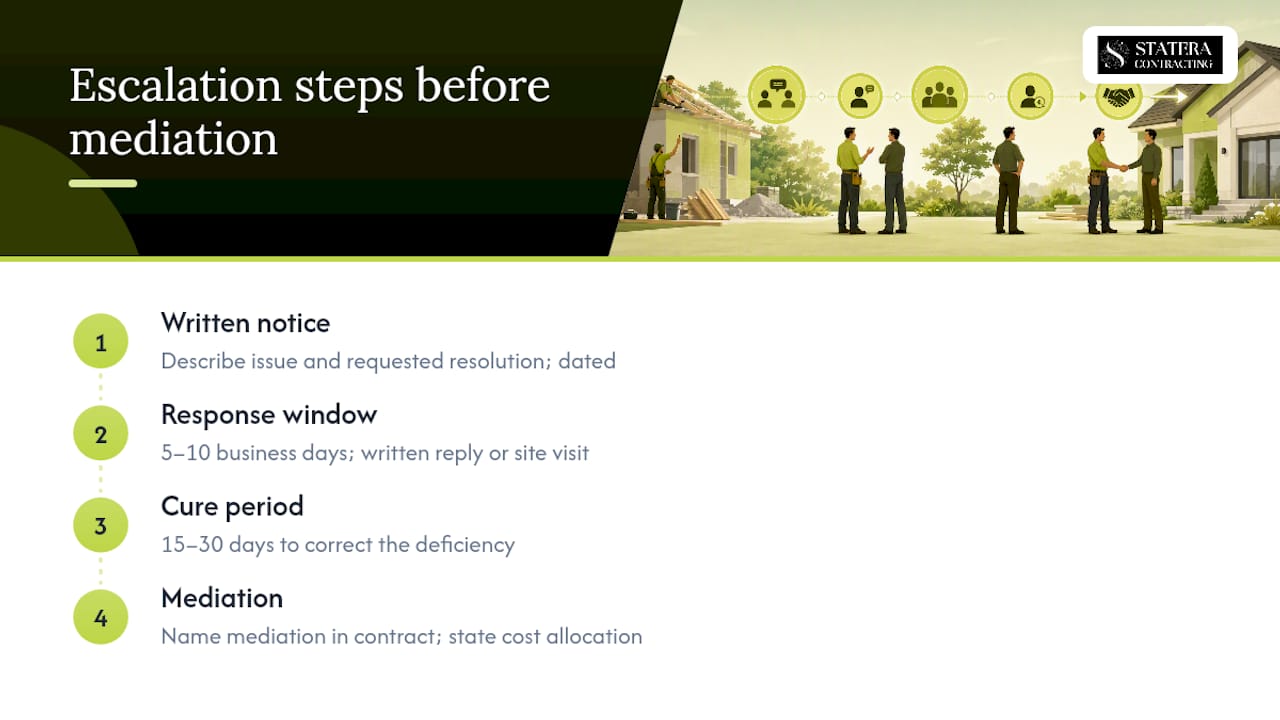
The first step is a written notice of the specific issue, sent to the contractor’s contact listed in the contract, describing the problem and the resolution you’re seeking. This isn’t a text message or a hallway conversation. It needs a paper trail with a date attached.
The second step is a defined response window, commonly 5 to 10 business days, during which the contractor must reply in writing, either proposing a fix, disputing the claim, or requesting a site visit to assess the issue directly.
The third step, if the issue remains unresolved, is a short cure period, often 15 to 30 days depending on the severity of the problem, giving the contractor a final opportunity to correct the deficiency before either party escalates further.
Only after those three steps fail does the contract move to mediation, which the Canada Construction Network recommends explicitly naming in the contract, along with who bears the cost if it’s split evenly or assigned to the losing party. Naming this sequence in the contract itself, rather than leaving it to be figured out mid-argument, is what actually makes the process usable when tempers are running short.
How contractors think about clauses, and how to negotiate them
Homeowners often assume clauses like deposit requirements or holdback timing exist to protect the contractor at their expense. Most of the time, that’s not the real story. A deposit sized at 10 to 15% of project value exists because contractors need to order materials and secure trade schedules before demolition starts, not because they’re trying to extract leverage.
Where negotiation actually helps is in how those trade-offs get structured. If a contractor proposes a larger deposit than feels reasonable, counter with a phased approach: a smaller deposit tied to material ordering, followed by the next payment at mobilization rather than lumping both into day one. If scheduling certainty matters to you, ask for a specific start date written into the contract with a modest credit for unexcused delay, rather than a vague “spring 2026” window.
Get every verbal promise added to the written contract before signing, no exceptions. And for any project over roughly $15,000, or one involving structural changes, a half-hour with a lawyer reviewing the CCDC 2 principles that underpin most standard contract language is worth far more than it costs.
— Patrick
How Statera Contracting handles contracts differently
Every residential and commercial renovation agreement should be built around the principle this guide walks through: a scope specific enough to eliminate guesswork, a payment schedule tied to real milestones, and proof of insurance and WCB coverage provided before work begins, not promised and forgotten. That’s the difference between a contract you sign and hope for the best, and one you can actually hold someone to.

If you’re planning a kitchen renovation in Calgary or a bathroom, basement, or whole-home project, Statera Contracting will share a sample contract on request so you can see exactly how these clauses look in practice before you commit to anything. Reach out for a consultation and ask for that sample alongside a project estimate. It costs nothing to compare it against whatever you’ve already been handed.
Sources
The clauses and language covered in this guide draw on the following resources, worth bookmarking if you’re negotiating your own contract:
- Home renovations - Office of Consumer Affairs
- What to put in a renovation contract (Treadstone Law)
- What to include in a renovation contract (Canada Construction Network)
- How to write a renovation contract that protects you (CAA-Quebec)