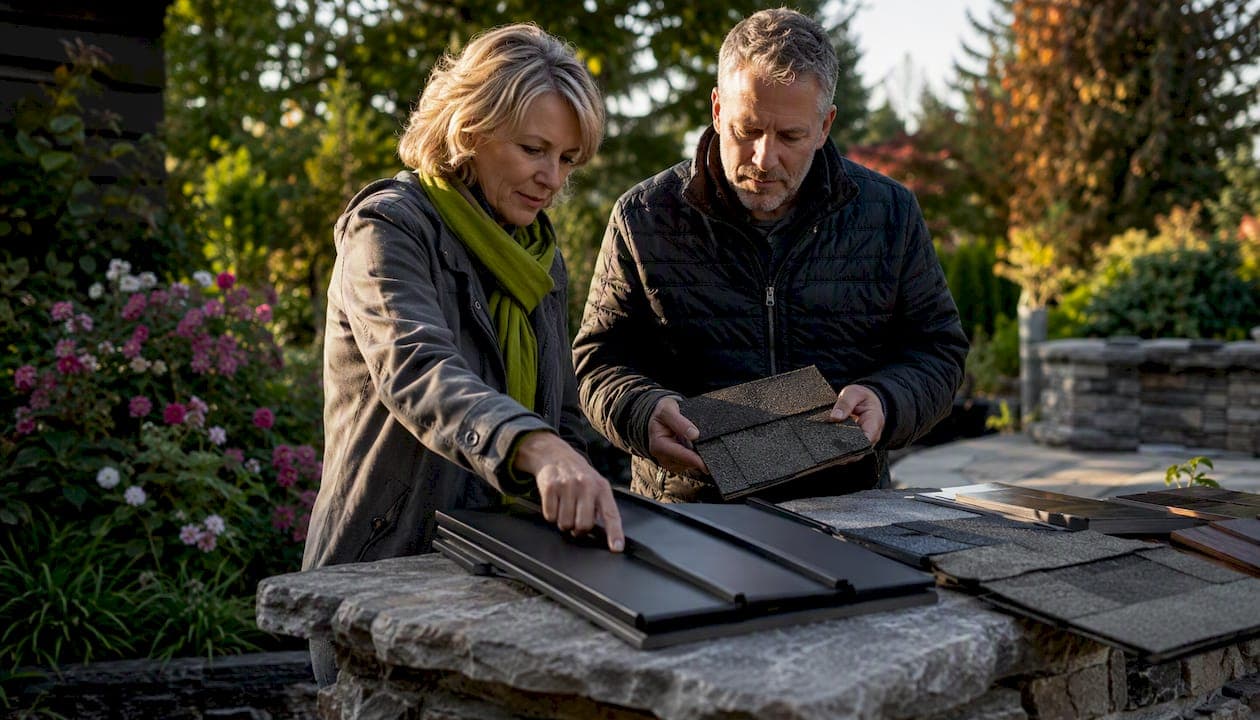
If you plan to sell within a relatively short period, architectural asphalt shingles are usually the smarter financial choice. If you expect to stay longer term, metal roofing typically delivers better lifetime value once you account for replacement cycles. That single ownership-horizon rule drives most of the decision. Statera Contracting works through exactly this framework with Calgary homeowners before recommending a system, since the “right” roof depends heavily on how long you plan to stay and what your local climate throws at it. Metal roofs last 40–70 years in Canadian conditions, while asphalt shingles are commonly rated 15–30 years and often fall toward the lower end in harsh freeze–thaw climates.
Table of Contents
- How do asphalt and metal roofs compare side by side?
- What does a roof actually cost in Canada, and which material wins over time?
- How does each material hold up in Canadian weather?
- What maintenance should you expect, and what are the warning signs?
- What should you know about installation before you get a quote?
- How do aesthetics and resale value factor into the decision?
- How do you choose the right roof, and what should you ask your contractor?
- Statera Contracting helps Calgary homeowners get the right roof
- Key takeaways
- A contractor’s perspective on choosing roofing materials in Calgary
- Trusted Canadian sources and further reading
How do asphalt and metal roofs compare side by side?
Here is how the two materials stack up across the dimensions that actually matter to Canadian homeowners.
Upfront cost: Asphalt wins clearly. Installed costs in Canada run roughly $4–$9 per sq ft for asphalt and $8–$22+ per sq ft for metal, depending on profile and region.
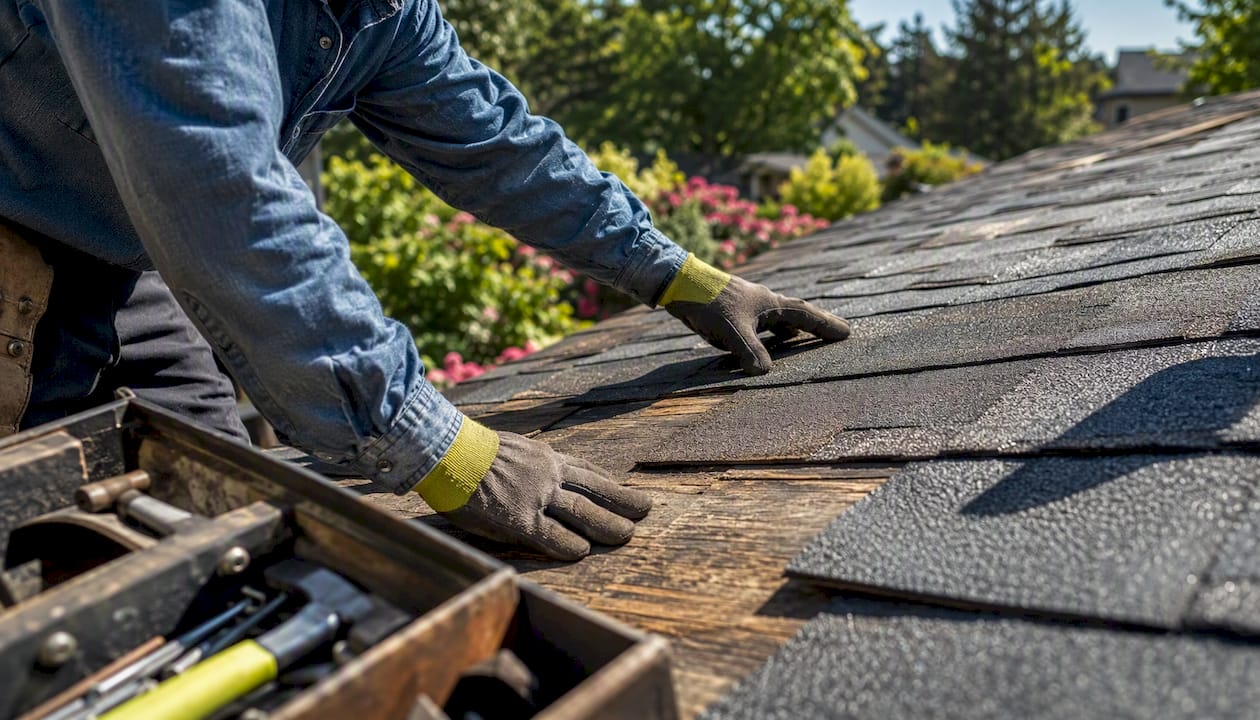
Life-cycle cost and lifespan: Metal wins for long-term owners. One asphalt roof may need replacing twice before a standing-seam metal roof reaches end of life.
Weather resistance: Metal holds the edge on hail, wind, snow shedding, and fire. Impact-rated Class 4 asphalt shingles close the gap on hail, but metal standing seam resists splitting outright.
Maintenance: Asphalt requires more frequent inspection for granule loss and curling, but individual shingle repairs are inexpensive. Metal needs periodic sealant and fastener checks, and repairs require a specialist.
Installation complexity: Asphalt is faster and simpler. Metal, especially standing seam, demands precise deck prep, thermal movement clips, and experienced labour.
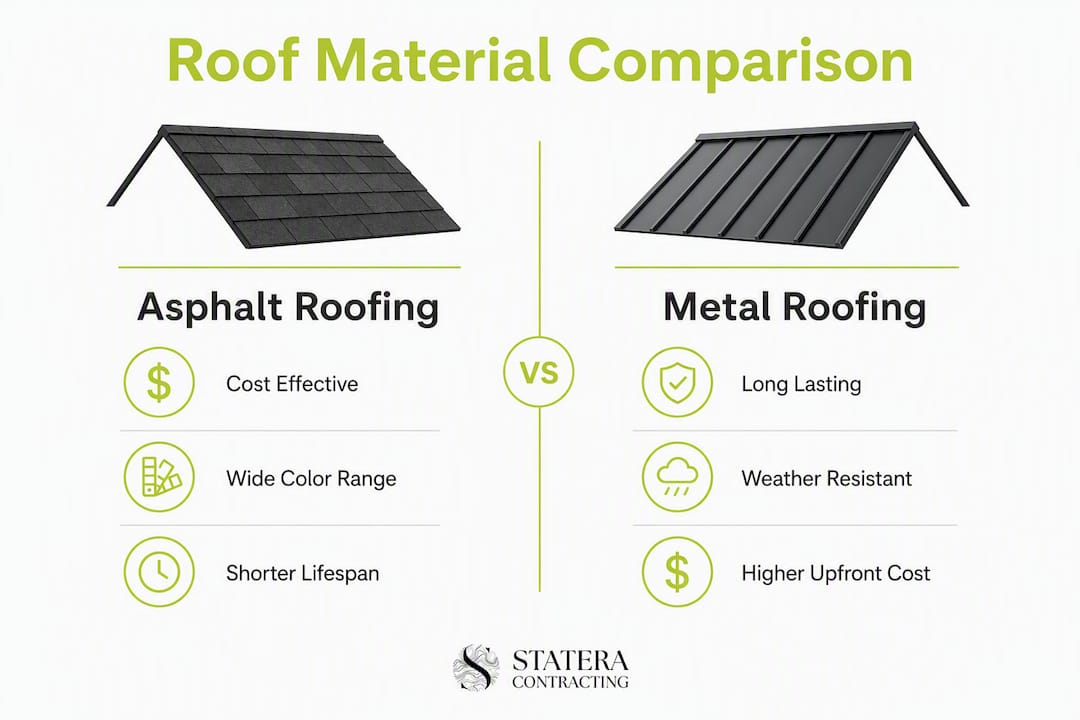
Warranty: Metal manufacturers typically offer 40–50-year paint and substrate warranties. Asphalt manufacturer warranties commonly run 25–30 years, though labour warranties are shorter for both.
Energy efficiency: Metal roofing tends to be more energy efficient due to higher reflectivity and compatibility with cool-roof coatings. The benefit is most pronounced in warmer regions; in Calgary’s climate, heating loads dominate and the cooling savings are modest.
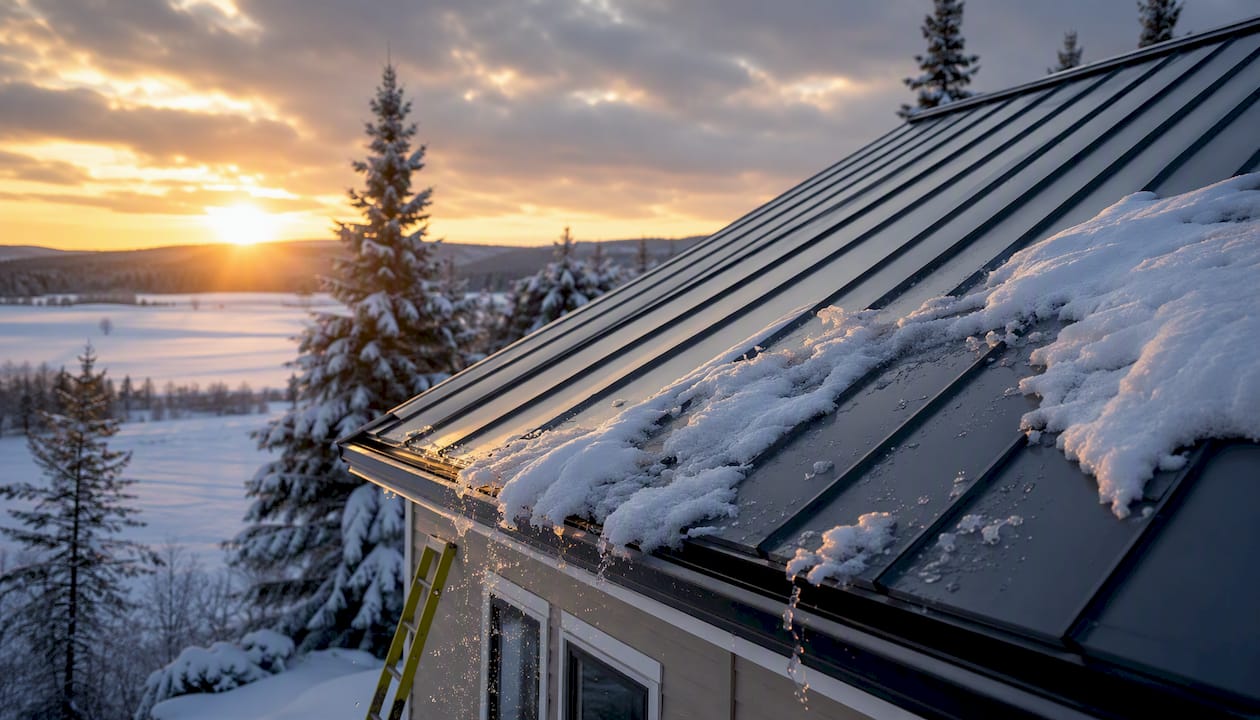
Aesthetics: Asphalt offers a wider colour palette and dimensional profiles that suit most neighbourhood styles. Metal panels, standing seam, and faux-shingle metal have improved significantly and suit contemporary or rural architectural styles well.
Environmental impact: Asphalt shingles generate significant landfill waste at end of life, though recycled asphalt shingles have road-base applications. Steel and aluminium metal roofing is largely recyclable at end of life.
Key trade-offs at a glance:
- Cost vs longevity: asphalt costs less upfront but needs replacing sooner, often twice in the time a metal roof lasts once.
- Maintenance vs repairability: metal needs less routine maintenance but costs more to repair when something does go wrong.
- Resale and aesthetics: asphalt is what most buyers expect in typical Canadian neighbourhoods; metal can add curb appeal in the right context but may not recoup its premium in a short sale.
What does a roof actually cost in Canada, and which material wins over time?
Installed price ranges for a 2,000 sq ft roof
Average roof replacement costs in Canada run $7,500–$18,000 for asphalt and $15,000–$36,000 for metal, with Toronto and Vancouver at the high end and prairie and Atlantic markets generally lower. On a 2,000 sq ft roof, the installed range works out to roughly $8,000–$20,000 for asphalt and $16,000–$44,000 for metal depending on system and region.
Within metal, corrugated and exposed-fastener steel sits at the lower end of metal pricing, metal shingles and concealed-fastener options fall midrange, and standing-seam or architectural metal commands the highest prices because installation complexity drives much of the spread. A 2026 pricing guide puts asphalt installed averages at $5–$10 per sq ft and standing-seam steel at $12–$25+ per sq ft, inclusive of tax and permit scenarios.
Lifecycle cost comparison over 50 years (2,000 sq ft example)
| Dimension | Architectural asphalt | Standing-seam metal |
|---|---|---|
| Upfront installed cost | Generally lower for architectural asphalt shingles | Generally higher for standing-seam metal roofing |
| Expected lifespan | Typically shorter for architectural asphalt shingles in Canadian climate | Longer for standing-seam metal roofing |
| Replacements in 50 years | Multiple replacements generally expected for asphalt shingles | Few or no replacements expected for metal roofing |
| Estimated 50-year spend | Can be higher for asphalt shingles when accounting for multiple replacements over time | Can be lower or comparable for metal roofing over long term |
| Amortised cost per year | Can be higher for asphalt shingles due to shorter lifespan | Can be lower for metal roofing due to longevity |
These figures use mid-range installed costs and assume no major price inflation. Your actual numbers will shift based on local labour rates, tear-off costs, and whether your insurer offers a discount for metal.
Variables that change the math
Ownership length is the single biggest lever. A homeowner who sells at year 12 never captures metal’s lifecycle advantage. Local labour rates matter too: Calgary’s trades market can push installation costs higher than the national average. Tear-off adds $1,000–$3,000 to any replacement, and skipping it on a metal install (overlaying directly on shingles) carries real risks covered in the installation section below. Insurance discounts for Class 4 or metal roofing in hail-prone Alberta can offset several hundred to a few thousand dollars over the life of the policy.
Pro Tip: The lifecycle math typically flips in metal’s favour somewhere between years 15 and 20. If you are confident you will stay past that point, run the numbers with your contractor using your specific roof size and local labour rates before ruling metal out on sticker price alone.
How does each material hold up in Canadian weather?
Canada’s climate is not uniform, and roofing performance varies significantly by region. Understanding where each material excels helps you match the choice to your specific location.
Snow, ice dams, and freeze–thaw
Metal roofs shed snow faster because of their smooth surface and low friction, which reduces the structural load and limits the conditions that create ice dams. Standing-seam metal uses expansion joints and floating clips to manage thermal movement, which also helps prevent the freeze–thaw cracking that affects asphalt over time. Asphalt shingles hold snow longer, and granule loss accelerates adhesive degradation, which can worsen ice-dam formation in Ontario, Quebec, and Alberta winters.
Hail and wind
In Alberta’s hail corridor, this distinction carries real financial weight. Impact-rated Class 4 asphalt shingles are widely recommended in hail-prone prairie markets, but repeated shingle claims can raise insurance premiums over time. Metal standing seam resists splitting outright and can reduce repeat-claim exposure. For wind, metal panels fastened with concealed clips perform well in high-wind events; asphalt relies on adhesive strips that can fail in sustained winds above the product’s rated threshold.
Wildfire zones and coastal conditions
Metal is non-combustible, which matters in BC’s wildfire interface zones and parts of Alberta. Asphalt shingles carry a fire rating, but they are combustible and can ignite from ember cast. On the BC coast and in Atlantic Canada, salt air accelerates corrosion on bare steel; Galvalume-coated steel, aluminium, or zinc panels are the appropriate choices in those environments. Moss growth on asphalt is a persistent maintenance issue on the wet BC coast.
Regional summary
- Prairies (Alberta, Saskatchewan): Hail frequency makes Class 4 asphalt or standing-seam metal the sensible shortlist. Insurance implications are real.
- Ontario and Quebec: Severe freeze–thaw cycles shorten asphalt lifespans; metal’s thermal movement management is an advantage here.
- BC coast: Salt and moisture favour corrosion-resistant metal alloys; moss on asphalt requires regular treatment.
- Atlantic Canada: High wind and salt exposure favour metal with concealed fasteners and corrosion-resistant coatings.
What maintenance should you expect, and what are the warning signs?
Asphalt maintenance checklist
- Inspect twice yearly (spring and fall) for granule loss, curling edges, and cracked or missing shingles.
- Check all flashings around chimneys, skylights, and valleys for lifting or separation.
- Confirm attic ventilation is clear; poor ventilation accelerates shingle aging from below.
- Clear moss or algae growth promptly; zinc strips along the ridge can slow regrowth.
- After any hail event, arrange a professional inspection before filing a claim.
Metal maintenance checklist
- Inspect sealant at penetrations and end laps every 3–5 years; reapply where cracking appears.
- Check exposed fasteners (on corrugated or screw-down systems) for backing out or washer failure annually.
- Touch up paint chips or scratches promptly to prevent rust on steel substrates.
- Clear debris from valleys and gutters; standing water around metal edges accelerates corrosion.
- Inspect clips and seams on standing-seam systems after major wind or hail events.
Common repair scenarios
Asphalt shingle repairs are straightforward and inexpensive: a roofer can replace individual damaged shingles in an hour. Metal repairs are a different matter. Matching panel profiles, gauges, and paint finishes requires a specialist, and fabricating replacement sections for standing-seam systems adds cost and lead time.
Red flags that warrant an immediate contractor inspection:
- Heavy granule accumulation in gutters or at downspout outlets (asphalt nearing end of life)
- Persistent ice dams despite adequate attic insulation and ventilation
- Rust streaks or visible corrosion spots on metal panels
- Loose or missing fasteners on exposed-fastener metal systems
- Daylight visible in the attic, or soft spots when walking the roof deck
Warranty and insurance interactions are worth verifying before any repair: some manufacturer warranties require licensed installers for repairs to remain valid, and insurance policies may have specific documentation requirements after a storm event.
What should you know about installation before you get a quote?
Full tear-off vs overlay
Installing metal directly over existing asphalt shingles is technically possible, but most experienced contractors recommend against it. Overlaying traps moisture between layers, hides damaged sheathing that should be repaired, complicates proper ice-and-water shield installation, and can accelerate deck decay. A full tear-off costs more upfront, but it gives you a clean inspection of the roof deck and eliminates hidden problems that surface later as leaks or structural issues.
Permits, ventilation, and ice-and-water shield
Municipal permit requirements vary across Canada. Calgary, for example, requires a building permit for a full roof replacement, and your contractor should confirm local rules and pull the permit on your behalf. Ventilation is non-negotiable: inadequate attic airflow shortens both asphalt and metal roof lifespans and can void manufacturer warranties. Ice-and-water shield at eaves, valleys, and penetrations is standard practice in Canadian climates and required under most provincial building codes.
Slope, complexity, and labour cost
Roof pitch and complexity drive labour costs significantly. A simple gable roof installs faster and cheaper than a hip roof with multiple valleys, dormers, or skylights. Standing-seam metal on a complex roof can take two to three times longer to install than asphalt on the same structure, which is a meaningful portion of the total project cost.
Pro Tip: For standing-seam metal, confirm that your contractor uses floating thermal movement clips rather than fixed fasteners. Fixed fasteners on a long metal panel will cause the roof to buckle or the fastener holes to elongate as the metal expands and contracts with temperature swings, which is a common failure mode in Alberta’s wide temperature range.
Check the Calgary renovation roadmap for guidance on sequencing a roof replacement alongside other exterior projects and permit planning.
How do aesthetics and resale value factor into the decision?
Style options for each material
Asphalt shingles offer the widest colour and profile range available in Canada. Architectural (laminate) shingles add dimensional depth and suit traditional, craftsman, and colonial styles. Premium designer shingles mimic slate or cedar shake convincingly. Metal has closed the aesthetic gap considerably: standing seam suits contemporary, modern farmhouse, and commercial-residential styles; metal shingles replicate the look of traditional profiles while adding durability; corrugated steel works well on rural properties and outbuildings.
Resale considerations
In most established Canadian neighbourhoods, asphalt shingles are what buyers expect. A well-maintained architectural shingle roof in good condition rarely deters a buyer. Metal roofing can add curb appeal and a “premium” perception, particularly in higher-end markets or on architecturally distinctive homes, but it does not universally command a price premium that offsets its higher installation cost on a short sale timeline.
For homeowners planning to sell within 5–10 years, a quality architectural shingle replacement is often the more defensible investment. For long-term owners, metal’s durability and lower maintenance profile can be a genuine selling point when the time does come to list.
- Match neighbourhood character: a standing-seam metal roof on a 1970s bungalow in a traditional suburb may look out of place; the same roof on a rural acreage or a modern infill reads as a premium feature.
- HOA or community standards: some communities have material or colour restrictions; confirm before committing.
- Paint and finish longevity: quality metal roofing finishes (PVDF coatings such as Kynar 500) are rated for 30–40 years of colour retention; cheaper polyester finishes fade faster and require repainting sooner.
How do you choose the right roof, and what should you ask your contractor?
Decision checklist
Work through these before requesting quotes:
- Ownership timeline: Are you staying 15+ years? Metal’s lifecycle economics start to make sense. Selling within 10 years? Asphalt is likely the better financial fit.
- Budget envelope: Can you absorb a $22,000–$40,000 installation, or does a $10,000–$18,000 asphalt replacement fit your current situation better?
- Local climate risks: Are you in Alberta’s hail corridor? A coastal or high-wind zone? A wildfire interface area? Each shifts the material calculus.
- Roof complexity: A simple roof keeps metal installation costs manageable; a complex roof with many penetrations and valleys raises metal labour costs disproportionately.
- Warranty needs: How important is a 40–50-year substrate warranty versus a 25–30-year shingle warranty?
- Insurance implications: Ask your insurer whether Class 4 or metal roofing qualifies for a premium discount in your postal code.
- Energy goals: If cooling costs are a concern (more relevant in southern Ontario than Calgary), metal’s reflectivity adds value. In heating-dominated climates, the benefit is smaller.
- Sustainability priorities: If recyclability and end-of-life impact matter to you, metal has a clear advantage. See the Alberta sustainable building materials guide for broader context.
Eight questions to ask every contractor before you hire
- What manufacturer warranty does this product carry, and does your installation qualify for the full term?
- What labour warranty do you provide, and what does it cover?
- Are you recommending a full tear-off or an overlay, and why?
- How will you address attic ventilation as part of this project?
- Where will you install ice-and-water shield, and what product are you using?
- For metal: are you using floating thermal movement clips or fixed fasteners?
- Can you provide two or three references for similar installations in this neighbourhood or climate zone?
- Are you carrying WCB/WSIB coverage and general liability insurance? Can you provide current certificates?
Red-flag answers: Any contractor who recommends overlaying metal on existing shingles without a clear structural reason, cannot provide insurance certificates on request, or offers a warranty verbally without written documentation should not receive your deposit.
Statera Contracting helps Calgary homeowners get the right roof
Calgary homeowners replacing a roof face a specific set of pressures: hail season, wide temperature swings, permit requirements, and a trades market where not every contractor has deep experience with both material types. Statera Contracting handles full exterior renovation projects in Calgary and surrounding areas, including complete roof replacements, full tear-off and deck inspection, permit handling, and project management from assessment through final inspection.

We assess your existing roof deck condition, confirm ventilation requirements, and walk you through the lifecycle cost comparison for your specific roof size and ownership timeline before you commit to a material. Whether you are leaning toward a quality architectural shingle system or exploring standing-seam metal for a long-term hold, we manage the full scope so nothing falls through the cracks on flashings, permits, or warranty documentation.
Ready to get a clear picture of what your roof replacement will actually cost and which material fits your situation? Request a quote from Statera Contracting and we will arrange an on-site assessment at your Calgary-area home.
Key takeaways
Metal roofing outlasts asphalt by decades in Canadian conditions, but asphalt shingles remain the better financial choice for homeowners who plan to sell within 10 years.
| Point | Details |
|---|---|
| Ownership horizon drives the decision | Stay 15+ years and metal’s lifecycle cost often matches or beats asphalt; sell within 10 years and asphalt wins on upfront value. |
| Canadian cost ranges | Asphalt runs $8,000–$20,000 installed on a 2,000 sq ft roof; metal runs $16,000–$44,000 depending on system and region. |
| Lifespan gap is significant | Metal lasts 40–70 years in Canadian conditions; asphalt commonly reaches 20–25 years in harsh freeze–thaw climates. |
| Prairie hail and insurance | In Alberta’s hail corridor, Class 4 asphalt or standing-seam metal reduces repeat-claim exposure and may lower insurance premiums. |
| Statera Contracting | Handles full roof replacements in Calgary, including tear-off, deck inspection, permits, and lifecycle cost guidance before you choose a material. |
A contractor’s perspective on choosing roofing materials in Calgary
The conversation we have most often with Calgary homeowners goes something like this: they have already decided on metal because they read that it lasts longer, and they are surprised when we suggest pausing before committing. Longevity is real, but it only translates to financial value if you are actually there to benefit from it. A homeowner who installs a $35,000 standing-seam roof and sells five years later has paid a significant premium for a feature the buyer may not value enough to reflect in the purchase price.
The other mistake we see regularly is homeowners accepting an overlay quote without questioning it. Overlaying metal on existing shingles is faster and cheaper on day one, but it is a decision that can hide rotting sheathing, compromise your ice-and-water shield, and create moisture problems that surface years later. We always recommend a full tear-off so we can see exactly what we are working with before anything goes on top.
Pro Tip: When you receive quotes, ask each contractor to show you the specific ice-and-water shield product they plan to use and where it will be installed on your roof plan. A contractor who cannot answer that question in detail is telling you something important about how they approach the rest of the job.
Trusted Canadian sources and further reading
- Green Building Canada: Metal Roofs vs Shingles — Lifespan data and sustainability comparison for Canadian residential roofing.
- Green Building Canada: Metal Roof vs Shingle Roof Cost in Canada — Detailed cost breakdown with provincial context.
- Homeowner.ca: Asphalt Shingles vs Metal Roofing — Practical homeowner comparison covering cost, maintenance, and repair.
- Roofing Calculator HQ: New Roof Cost Canada 2026 — Permit-aware pricing guide with regional scenarios.
- Asphalt Roofing Manufacturers Association — Industry specifications and product standards for asphalt shingles.
- Statera Contracting: Calgary Renovation Experts — Local Calgary contractor for roof replacement, exterior renovations, and permit-managed projects.
- RidgeCap GC: Roofing Project Gallery — Visual reference for roofing material finishes and installation styles.
Recommended
- Renovating an older home: what Alberta homeowners need to know | Statera Contracting
- Home renovation tax credit in Canada: 2026 guide | Statera Contracting
- Sustainable building materials: your Alberta guide | Statera Contracting
- Adding a second storey to your house: Canada planning guide | Statera Contracting